
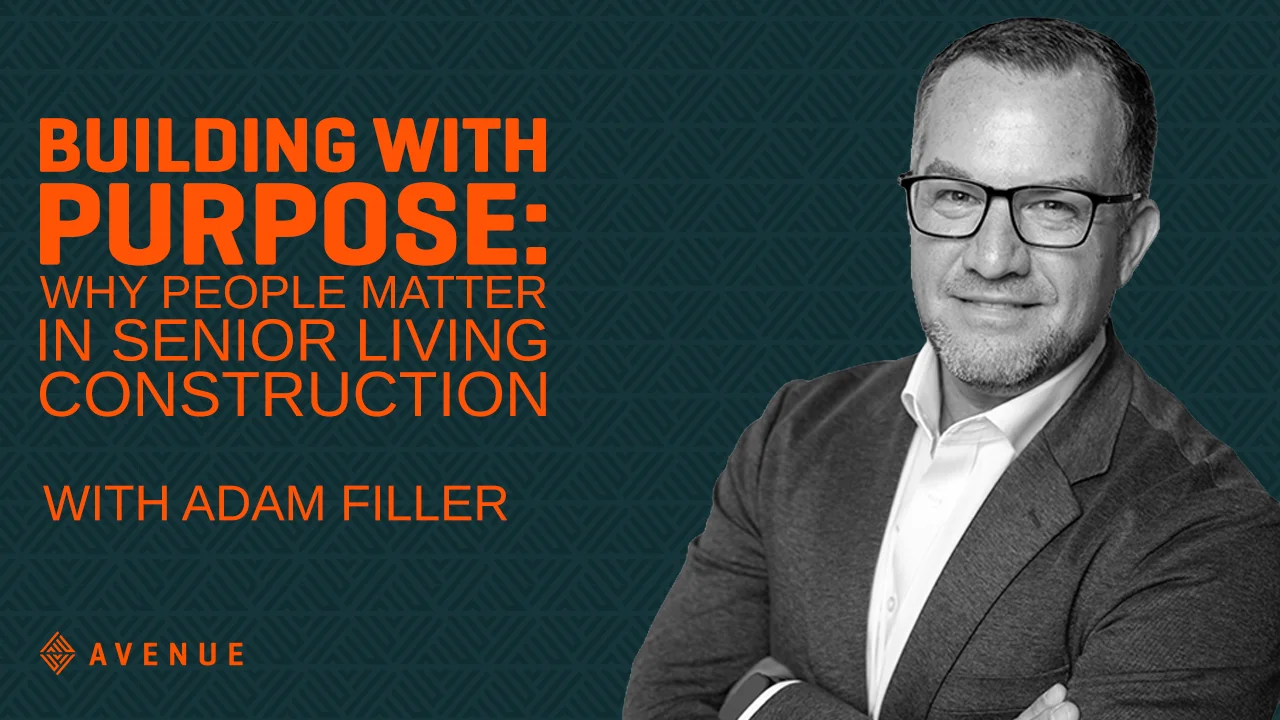
Adam Filler, President of Avenue Construction, has spent more than two decades in the construction industry. His career has taken him from healthcare and education projects to senior living, where he developed a deeper understanding of the purpose behind the communities he was helping build.
Over the past four years at Avenue, that experience has shaped Adam’s approach to hiring, decision-making, and project delivery, as well as his commitment to creating opportunities for employees as Avenue Construction grows.
Adam shares how he found his way into senior living construction, what he wishes he had known four years ago, what makes him proud of the work Avenue has completed, and what he hopes to accomplish next.

How did you end up in the senior living and healthcare construction industry?
I started my construction career in the medical sector, specifically on hospital replacement projects. That was a big part of the market when I entered the industry in 2004 and 2005.
When that work cooled off, I transitioned into school projects and later worked in an interiors division. Eventually, the company I was with started taking on senior living projects, and I transitioned back into project management.
Getting into senior living really happened by chance. We were working with a developer who started doing a lot of senior living projects, and my VP of operations, Brent Bauters, and I were fortunate enough to work on them. We started in Indiana and eventually worked on projects farther west in places like Colorado and Kansas City.
At first, I approached them like any other construction project. As a general contractor, I was focused on construction. As I spent more time in the industry, I started learning the different systems involved and understanding the challenges facing the senior living market.
It was when I started working with Avenue Development that I gained a much better understanding of what we were actually building and why.
Avenue Development Founding Managing Member Laurie Schultz has done a great job educating me on the overall purpose behind the work. There is a very real need for these communities, and as the builder, our responsibility is to create a safe environment for people to live, age, and remain healthy for as long as possible.
Over the years, I came to understand the purpose behind the projects, and that has become a huge part of why I enjoy the work we are doing today.
How do you create an environment where people feel empowered to make decisions?
It starts during the hiring and onboarding process. We tell people that they have the authority to make decisions. We hired them for a specific role because we trust their judgment and believe they will keep the best interests of the project and the company in mind.
That also means accepting that sometimes they will make the wrong decision. I do not want one bad decision to hold someone back from making another decision that could move us forward. When something does not work, we can talk about why it did not work, make an adjustment, and carry that lesson forward.
I never want a superintendent or project manager calling me for approval to put down temporary stone so they can get a delivery in. They are there, they understand what is happening in that moment, and they need to be able to make that call.
If we want people to grow, we have to trust them with that responsibility and support them through the decisions they make.
What do you know today that you wish you had known four years ago?
I wish I had Culture Index as part of our hiring process earlier. I know it would have saved us money, but more importantly, I think it would have helped us build better project teams.
It gives us a lot of information about who someone naturally is versus who they think they should be. That helps us understand how closely a position aligns with someone’s natural tendencies and how much they may be stretching to perform in that role.
To me, that is part of creating a good culture. If you are spending the majority of your time doing work you enjoy and that aligns with how you naturally operate, that goes a long way.
That same learning mindset carries into our projects. Our scopes of work, for example, have gotten tighter year over year because we have identified gaps and made adjustments. We may find something during construction that needs to be carried forward into the design or estimating process on the next project, or introduce technology that helps us identify something in the drawings earlier.
Every project gives us something we can use to improve the next one.
What makes you proudest about the teams and the communities you have built so far?
I am proud of our ability to deliver on our commitments and complete these projects for our clients.
It sounds simple, but it is not. An average project may have 30 to 40 subcontractors working within a schedule while navigating weather, changes, and other challenges along the way.
I am also proud to know that the people we have will work through those roadblocks with the best interests of the owner and the project in mind. That means looking ahead, identifying issues, and working with the design team and owner to find solutions that work.
It still amazes me that we take drawings and turn them into an actual building. Technology continues to change how we do that, from 3D modeling and clash detection to AI tools that can identify issues earlier, but it still takes people to build it.
That is what makes construction such a rewarding profession. You get to work with so many different people and create something out of nothing.
What are you most excited to learn and accomplish in your next four years?
I am excited to grow.
I think we have built a good platform for the company, and we are putting key pieces in place that will allow us to take on more projects and continue working in our existing markets at a higher capacity.
As the company grows, people have opportunities to expand their roles, take on more responsibility, and move into leadership positions. That is important to me because I want people to continue building their careers here.
I have been in a position where a company becomes stagnant, and you feel like you have hit a ceiling. For high achievers, having a career path ahead of them matters.
Continuing to grow Avenue gives our employees room to pursue their goals and build the careers they want.