
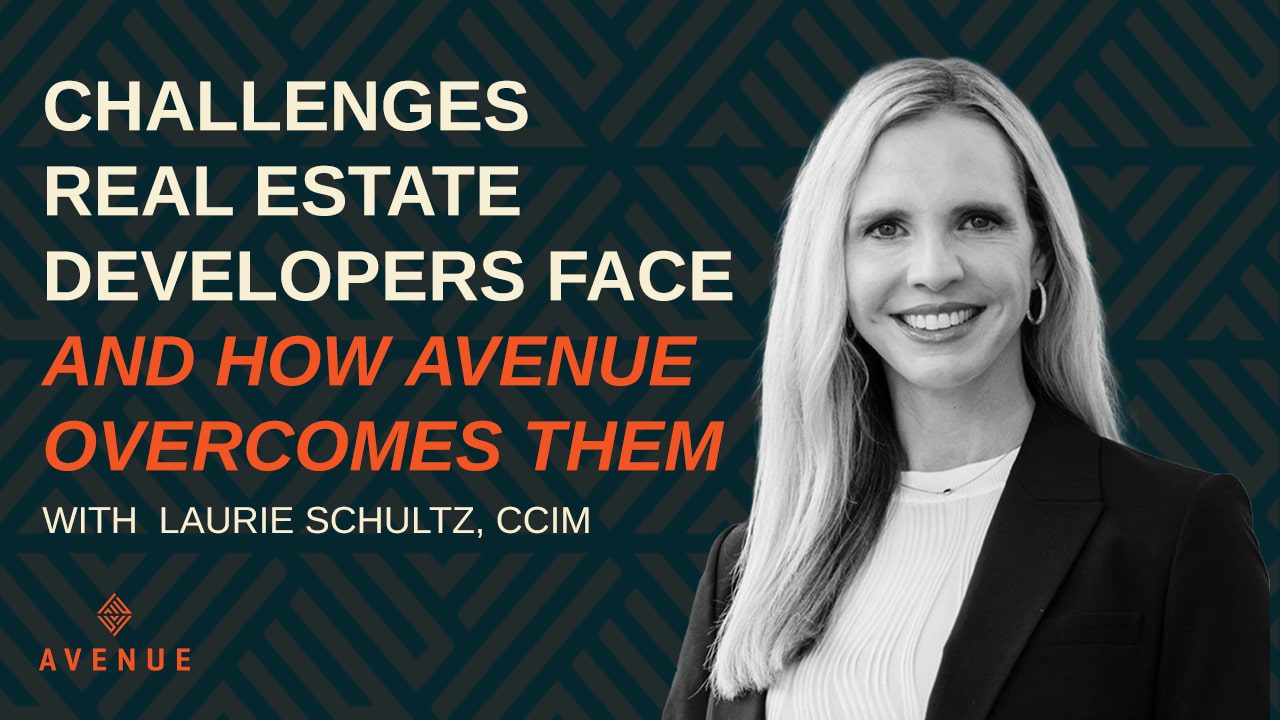
Development in senior living is a complex task, but as a specialized development and construction team, Avenue has developed specialized processes to face these complex challenges and deliver results. To break down how this works, we sat down with Avenue principal and co-founder, Laurie Schultz, for a special interview.
Q: What are the biggest challenges developers are facing right now across the senior living sector?
I’ve been in the development industry for 23 years now, and the last couple of years have been the most challenging in my career that I have seen. Of course, this industry in real estate in general goes through cycles. That’s to be expected. This feels different, though. This feels like it’s not just a cycle. We’re going through some steps. We are going through systemic changes to the development industry that are going to be with us for years and possibly decades to come.
One of the ways that Avenue has been successful in continuing to develop and construct during this new period is by integrating construction. Almost four years ago, we brought Avenue Construction in-house with our amazing president, Adam Filler, to lead the charge. And it is a combination of extreme expertise in senior living, multifamily, and active adult construction. That is one of our main focuses, along with healthcare and specializing in that product type, along with long-term development expertise. Combining those two allows us to underwrite projects more accurately.
Earlier in the development cycle, we focus on projects that work financially for our partners and us, and we minimize development spend on projects that will not work because we know we can get within several percentage points of a budget very early on in the process. Also, during construction, it is incredibly important to work with a general contractor that you can trust.
And candidly, that was a problem that we had for years, and why we wanted to integrate Avenue Construction with Avenue Development and make a cohesive team. We wanted to know if schedules were being met and if there was a problem hitting a schedule, so that we could work on that collaboratively with our team. There is nothing worse than coming up to the end of a project and telling residents they don’t have a move-in date because residents are selling their homes, they’re moving out of a prior apartment, or they’re moving out with family.
These are their lives. And having specific dates that you can rely on is incredibly important. It’s also important for the budget. We only have so much operating capacity that we can have in this new environment, and a project can pencil a return for our investors and ourselves. And having a handle on what that operating cost is going to be on that timeline for construction is vital to the success of the project.
Q: How does Avenue manage risk while still moving projects forward?
Risk is inherent in development and construction, and if you’re not risk-tolerant, you shouldn’t be in this business. It’s something that we deal with day to day, even hour to hour. Management of risk is why our investment partners want to work with us. It is one of the expertise points that we have as a team, and it is because of the longevity that our leadership has had in these respective industries.
Of course, it’s our knowledge, longevity, understanding of problems as they happen, but also being able to foresee some of the problems before they do. But at the end of the day, in this business, problems are going to happen all the time. And what sets Avenue apart and how we manage that is our teamwork approach and communication internally to handle that risk and those problems as they happen, and to be transparent with all of our partners.
Q: How does your team’s experience allow you to navigate complexity more effectively?
Similar to risk being inherent in development, development and construction have gotten harder. It’s gotten more complex, especially in the last decade. Gone are the days of an easy site where you find a greenfield. You get it under contract. You may or may not have to rezone it. You design it, you build it in a year, and you’re open. Every project now, especially projects that are hitting the demographic and psychographic pinpoints that we want for our residents. A lot of times, they’re in infill areas now or in the outskirts of suburbs that have a lot of development around them, and development is complex.
You’re having joint ventures with landowners, and you’re having joint ventures and partnerships with municipalities. You have many different cross-use agreements, easements, and restrictive covenants on these properties than you ever had before. And the list of documents and time that it takes to get through this is, it almost seems, never-ending on a project.
But if you have a team that’s experienced in that, in risk mitigation and understanding how to form those joint ventures and how to navigate through the complexity, that is vital to the success of the project. It is also important to have a team that’s experienced, to know when those right moments of a project might not work because of the complexity. And I think understanding the timing of when to keep going and pushing and when, sometimes, to let go of a project is just as important.
Q: What mindset do you think separates successful developers from stalled ones in this market?
If you want development to be successful, it’s very similar to the attributes that make an entrepreneur successful. You have to find a way through the hard moments. Life is going to get gritty. Developments are the same way. Nothing is ever going to go as planned. And we say that a project is like a cat. It has nine lives, and it dies, and you have to find a way to bring it back to life with creativity and also with a teamwork approach that everyone can win. If you find a way to do it together.
Q: Where does alignment between development, design, and operations make the biggest difference?
The evolution of Avenue over the last 11 years has been very interesting. For my partner, Mike Mattingly, and me, our thought process has certainly changed over the last decade. When we were starting out, we thought that just developing the project on time and on budget was the most important thing. And as long as we did that, the project was going to be successful.
That was an incredibly naive notion that over the years has changed; the true heart of the success of any development is what is happening to the lives inside that building. The heart of success is the operations. And so understanding how to underwrite the bricks and mortar, which are obviously the expensive pieces of a development, and the investment that people are making in the real estate.
But understanding the operational model and how that truly integrates and can be successful in your lease-up time means the rents that you’re going into the market with the programming that you have. That’s truly what makes the success. And then you layer in what we call the cherry on top of the design of the building. That gives it that off factor for residents to say, that’s aspirational to me. I want to live there. When you have those three pieces, and that is truly integrated, whether that’s all in-house or you find the right partners to do that together, that’s when magic is going to happen in your community.
Conclusion
Senior living development today demands far more than simply delivering a project on time and on budget. As market conditions evolve, sites grow more complex, and financial pressures increase, success requires a deeply integrated approach, one that balances operational foresight and thoughtful design. As Laurie Schultz outlines, the challenges facing developers are systemic and long-term, making adaptability more critical than ever.
Avenue’s approach, integrating development, construction, and operations, allows our team to navigate uncertainty with confidence while keeping residents, partners, and investors at the center of every decision. By prioritizing collaboration, accountability, and alignment across disciplines, Avenue is able to move projects forward responsibly, even in the most demanding environments. In an industry where the true measure of success is the lives lived inside each community, this holistic mindset is what turns complexity into opportunity and vision into lasting value. Contact us today to learn more.