
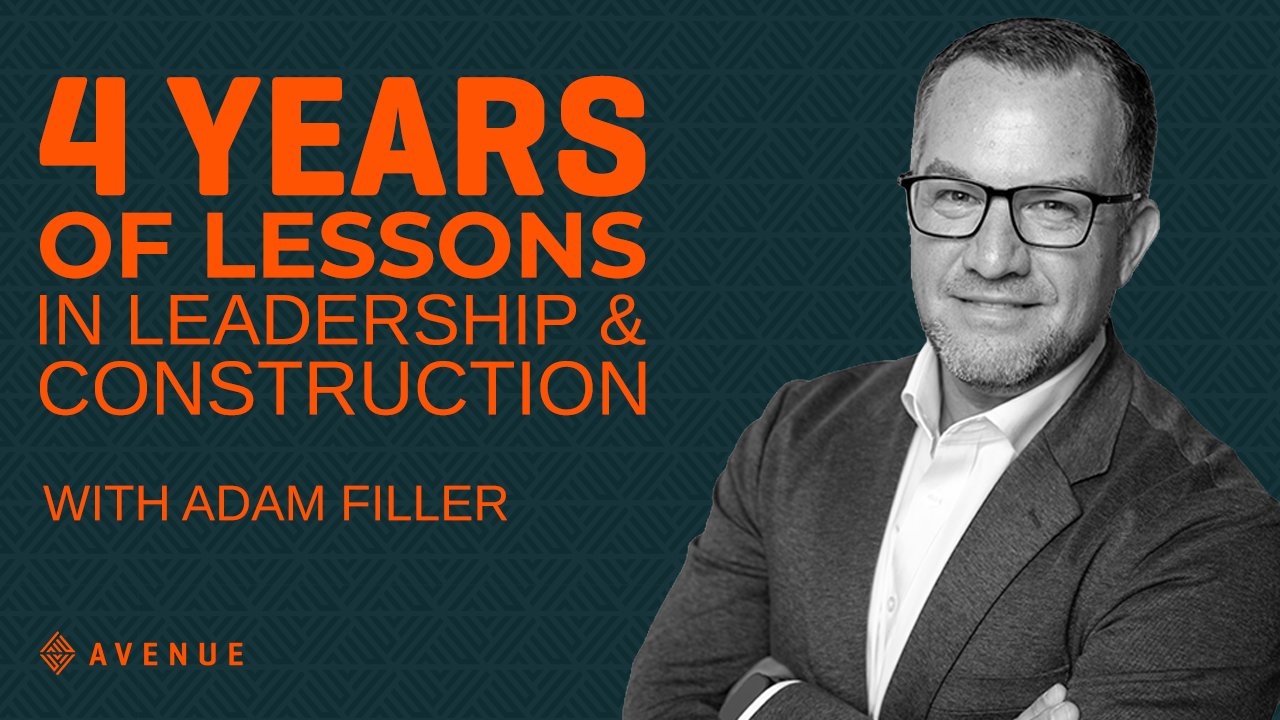
Adam Filler, President of Avenue Construction, has spent his career navigating the challenges of taking construction projects from plans to completion. But over the past four years, his role has expanded beyond managing individual projects to building and leading a construction company.
That shift has given him a different perspective on lessons he heard throughout his career but did not fully understand until he experienced them himself.
Adam shares what has changed since Avenue Construction started in 2022, how his approach to leadership has evolved, and why people, culture, and relationships have become such an important part of how he thinks about the business.

You’ve now been with Avenue for four years. When you look back, what stands out most?
I have had a lot of moments over the last four years where something a former business owner or leader told me years ago suddenly made sense.
You can hear someone explain an experience, but until you are building a business yourself, you do not always understand what they were trying to tell you. There have been times when something happened, and I thought, “Now I get it.”
Not all of those experiences have been great, but they have shaped how I think about the business.
When we started in 2022, Brent and I were heavily involved in operations and running projects. As one project became two and the business continued to grow, my role had to change.
How has your approach to leadership changed during that time?
One conversation with Laurie Schultz really changed my perspective. During a board meeting, she asked whether I wanted to run the company or be in the company.
At first, I did not understand what she meant. I was working hard and heavily involved in operations. Eventually, I realized that was exactly the point. If we wanted the company to grow, I had to step back from solving every project issue myself and spend more time building the company.
Over the last year and a half or two years, that has meant focusing more on adding personnel, creating processes, working with accounting on reporting and cash flow, building backlog, and developing our culture.
I still enjoy working through project problems, but I cannot be involved in every project. Leadership now means ensuring we have qualified people to lead that work.
What have you learned about building the right team?
Having good people makes a huge difference.
One lesson for me has been that a strong résumé and good references do not automatically mean someone is right for a role. You have to understand what they can actually do and whether the position fits the way they naturally work.
We now use Culture Index as part of our hiring process to give us another perspective on that fit. We have also used it with our existing team to better understand how we communicate and whether people are in the right roles.
Culture is part of that, too. You are not creating a culture based only on what you want as a leader. You have to build an environment that works for the people around you.
For us, learning, teamwork, client satisfaction, and integrity are important parts of that environment.
Why are relationships so important when bringing a construction project or community to life?
It takes relationships throughout the entire process to get a project done.
The developer takes on risk choosing a market and bringing a vision forward. Architects and engineers take on responsibility for designing to the standards of that market. The general contractor has to help guide the design within the budget and rely on subcontractors to perform. Subcontractors have their own risks around labor, materials, and costs.
Everyone is coming to the project with a different responsibility and perspective.
To me, a good working relationship means understanding those perspectives. It requires trust, open communication, and a willingness to go further for each other when the project demands it.
Sometimes that means being open about something that was missed and explaining how you are going to correct it. Sometimes it means asking for help. Being a good partner means communicating those issues and trusting that everyone will do their part.
How do client relationships influence the decisions you make?
One of the harder lessons has been understanding when the best decision for the business is not necessarily the decision that creates the greatest immediate financial benefit.
There may be a situation where we could pursue a change order, for example, but taking care of the issue and moving forward may be better for the client, the architectural team, and the project as a whole.
Those decisions are not always easy, but I have learned that client satisfaction has to come first. You have to look beyond one decision and consider the overall project and the long-term relationship.
What separates a good project team from a great one?
Accountability is a big part of it.
Every part of a project affects what happens next. If the building is not completed on time, that can affect the owner’s construction loan, when residents can move in, project performance, and future opportunities.
When something falls behind, you have to be willing to talk about it and figure out what needs to happen to get back on track.
Sometimes that requires more hours, additional resources, or leaning in more than you originally expected. At the end of the day, everyone is working toward the same goal: getting the project completed successfully for the client.
Four years into Avenue Construction, I am still learning. But I understand a lot more clearly today why the business owners and leaders I worked with throughout my career placed so much importance on people, communication, relationships, and accountability.
Sometimes you have to experience those lessons yourself before you fully understand them.
Connect with Avenue to learn more about our approach to development and construction.