
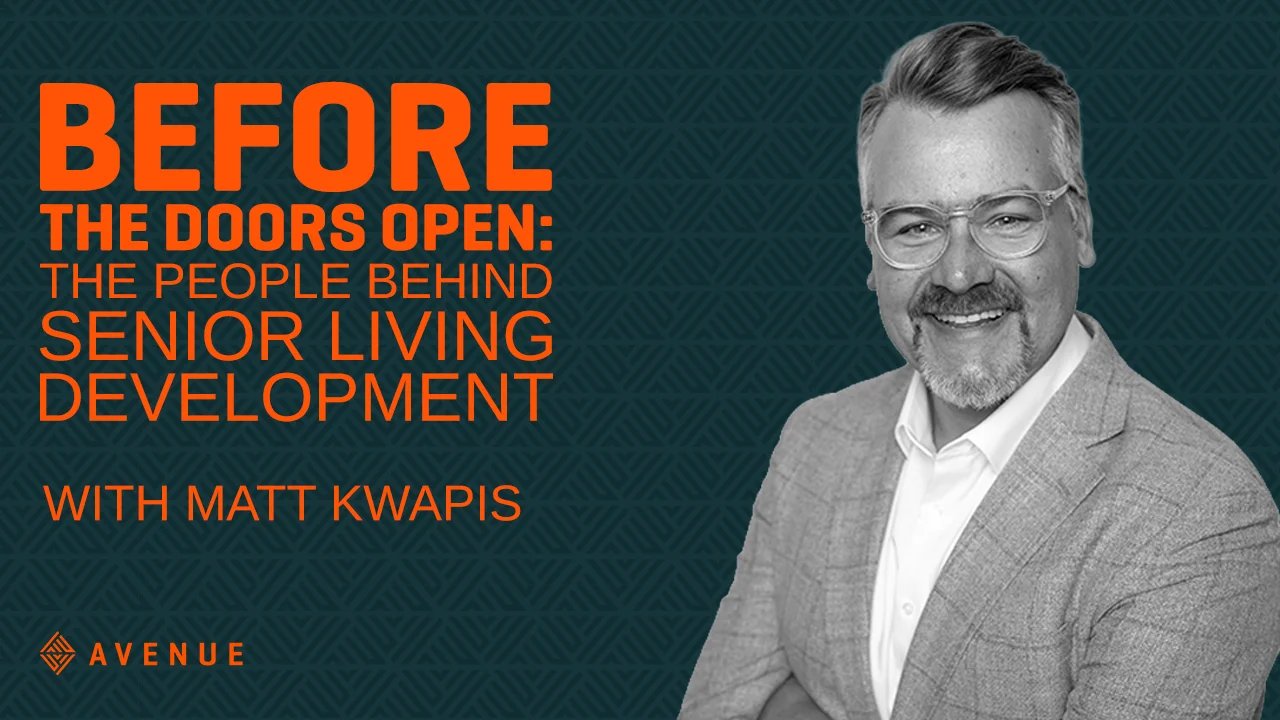
Before the doors open, a senior living community has already been shaped by hundreds of decisions. Land, design, budgets, and construction are part of the process, but Matt Kwapis, SVP of Development at Avenue, says some of the most important considerations come back to people: the residents who will live there, the teams who will work there, and the partners who help bring the community to life.
In this conversation, Matt shares what has kept him in senior housing for more than a decade, why development teams need to think about the end of a project from the outset, and how decisions made long before construction can influence how a community functions for years to come.

You have spent more than a decade working in senior housing. What initially drew you to the industry, and what has kept you connected to it?
I really fell into senior housing by chance. Coming out of college, I had the opportunity to join a company that exposed me to the inner workings of the industry, and I have never wanted to leave.
There is a real sense of purpose behind the work. We get to do something we enjoy while knowing that, at the end of the day, the communities we develop can help seniors live well in their later years. I think a lot of people who have spent time in this industry feel that connection, and it is what has kept me here.
When people hear the word development, they may picture land, plans, budgets, and construction. What do they often misunderstand about the human side of your role?
The people side of development may be one of the biggest parts of what we do every day.
We work with municipalities and communities, helping them understand why senior housing is an important part of the broader community. We work through planning commissions and approvals, and listen to stakeholders’ needs for a project.
But the resident always has to stay at the center. The person who eventually calls the community home does not care what we paid for the land or how long the zoning process took. They care about whether they enjoy where they live and whether they can receive the support they need. That perspective can easily get lost in all of the technical parts of development, but it cannot be an afterthought.
At the beginning of a project, whose perspectives need to be represented before the team can make the right decisions?
I like to think about the end of the project at the beginning.
That means thinking about both groups of people who will use the community every day: the seniors who will live there and the people who will come to work there. Both need to be able to use the space successfully.
Design and construction are obviously critical, but those disciplines cannot make up for decisions that do not serve the building’s users. Working backward from the resident and team member experience helps us evaluate the project through the lens of how the space will actually function once the doors open.
Can you share an example of a time when listening to an operator, team member, resident, or project partner changed the direction of a project?
One thing I have learned in development is that being responsible for delivering the building does not make me an expert in every part of it. Relying on development and operating partners is critical because they are ultimately responsible for making the community work once development is complete.
On one project, we were working through the challenges of a particular site. We identified an opportunity to save time and money by putting the memory care neighborhood on the third floor. On paper, there were reasons it could work.
But that option also meant considering kitchen placement and how staff would work in the space. After weighing those operational needs, the benefits of keeping memory care on the first floor outweighed the potential savings.
Delivering a project on time and on budget matters, but those measures alone do not make the development successful if the space does not work well for the people who inherit it.
Many of the most important development decisions are made before anything is visible on the site. Which early decisions have the greatest influence on how people will eventually experience a community?
Underwriting is one of the most important places to start.
Before we put lines on paper or move toward construction, we need to understand the market and appropriately underwrite the opportunity. That requires trusted partners who can deliver a complete, honest market study to inform decisions about unit mix and rates.
Those findings eventually influence decisions such as unit mix and rates. You can make assumptions that improve a pro forma on paper, but the development still has to perform in the real market once it opens.
Spending the time to understand the market before design and construction begin gives the rest of the project a stronger foundation.
When you walk through a completed community, what tells you that the development team truly understood the people for whom it was creating the space?
The best indicator comes after the excitement of opening day has passed.
An open house is rewarding because everyone is excited to see the finished community. But coming back a year later and seeing residents who are still happy with where they live, and team members who enjoy working there, means even more.
The smiles from residents and staff, the hugs, and the appreciation for the finished community are what make the work rewarding. Seeing people enjoy where they live and work is the strongest sign to me that we understood who we were building for.
When you think about the places Avenue is creating today, what do you hope people understand about the teams that made them possible?
It is easy for one person to become the face of a development. That may be the person presenting to the planning commission or the person whose name appears publicly alongside the project.
The reality is that entire teams are working behind the scenes every day to keep development moving.
Something as routine as processing pay applications and making sure contractors are paid requires an enormous amount of attention. That work supports our partners and helps the project stay on schedule, even though most people will never see it.
The same is true of the support teams in the office and everyone else handling the details that keep projects moving. Development is never the work of one person. There are many people behind every community, and their work makes the finished project possible.
Successful senior living development comes back to keeping the people who will eventually live and work in a community in mind throughout the process. The building may be the most visible result, but how well it works once the doors open tells us whether we made the right decisions.
Explore Avenue’s portfolio to see the communities these teams help bring to life: https://avenuedev.com/portfolio/